Clara Whitfield in her kitchenMe, in my kitchen
The Tried It Manual, the book

858 pages99 chapters, 15 parts. PDF and EPUB, on any device.

The 30-Day Kitchen Money Challenge, the workbook
The Tried It Manual858 pages · 99 chapters · PDF + EPUB · 7-day refund
$9.99

The 30-Day Kitchen Money Challenge is free.

Clara Whitfield · from Clara Tried It and Better Ask Clara

The most expensive thing in your house is everything you were told you have to buy.

Ninety-nine things I tried in my own house, and what happened. Including the ones that did not work, because those turned out to be worth more than the tricks. No skills needed, and nothing beyond what is already in an ordinary kitchen.

$9.99 · 7-day refund

Get the free 30-Day Kitchen Money Challenge and chapter one

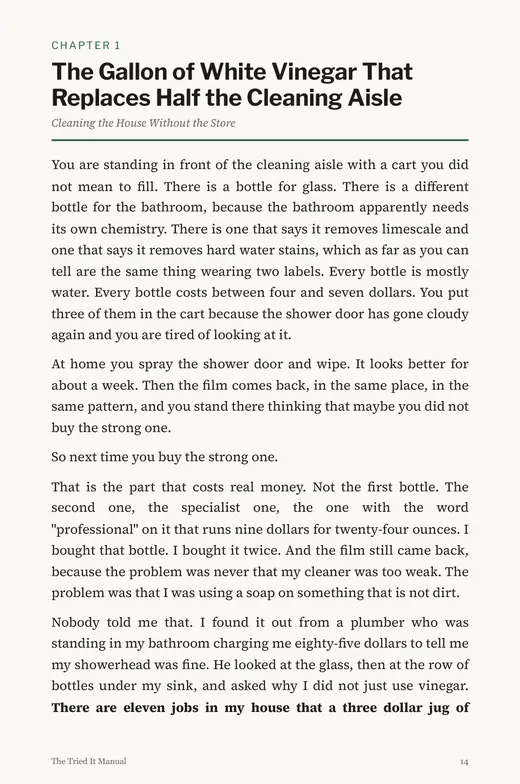
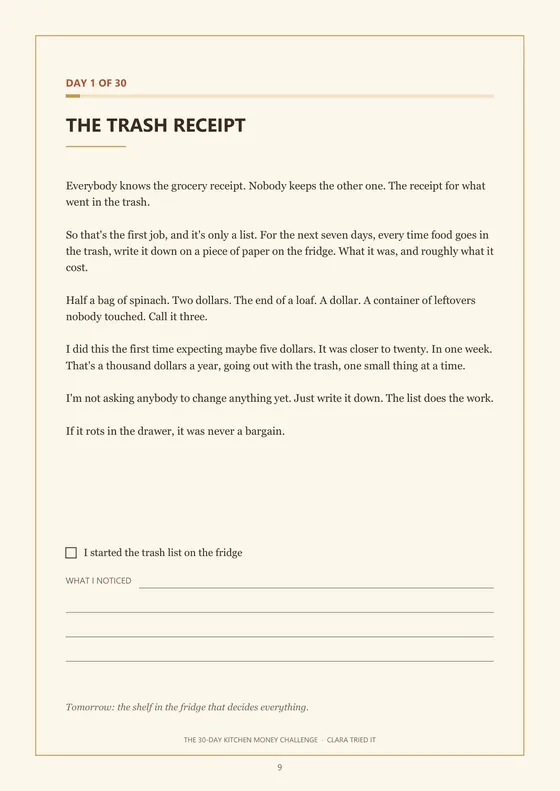
Put your email in the box and two things open on the very next page, both free: the whole 30-Day Kitchen Money Challenge, and Chapter 1, The Gallon of White Vinegar That Replaces Half the Cleaning Aisle. Thirty days, one kitchen habit each, with the arithmetic shown. There is nothing to install and no card to enter.

The first page of the free chapter

We keep your address so Clara can write to you now and then with something worth reading. One click stops it for good. We never sell it and we never pass it on.

Your house runs on numbers nobody ever checks.

These are them. Not my numbers, the government's: what an ordinary American household actually spends in a year, from the Bureau of Labor Statistics and the Energy Information Administration.

The green line under each one is which parts of the book go after it. I am not going to print a figure for what you will save, because I do not know your house or your prices. I will tell you where the money goes.

$9.99. Once. The bills come back every year.

Get the Manual · $9.99
An ordinary houseWhat one year actually costs
Food eaten at homeBLS, Consumer Expenditure Survey$5,700 to $6,300
Stretching what you already bought, the pantry, the freezer and the weekly shopParts 3, 5, 6 and 12 · 28 chapters
Food thrown away uneatenUSDA and EPA household waste estimates$1,300 to $1,600
Knowing what is thirsty and what is finishedChapters 22 and 23, and Part 6
Housekeeping suppliesBLS, housekeeping supplies$800 to $950
Eight things from ordinary shops, and the four they replacePart 1 · 8 chapters
Electricity and gasEIA, Residential Energy Consumption Survey$1,900 to $2,400
The dial nobody touches, and holding heat at the glassParts 10 and 11 · 12 chapters
Clothing, and replacing itBLS, apparel and services$1,700 to $2,000
The stains people give up on, and five-minute mendingPart 14 · 5 chapters
Pest control and small repairsBLS, household maintenance$400 to $700
Nine pests, and the three faults worth fixingParts 2 and 9 · 15 chapters

Fifteen parts, aimed at every line

Sources: US Bureau of Labor Statistics, Consumer Expenditure Survey · US Energy Information Administration, Residential Energy Consumption Survey · USDA and EPA household food waste estimates. What you keep depends on your house, your prices and how much of it you actually do. This book prints no savings figure of its own, and it says why.

I tell you when it does not work. That is most of what this book is for.

Clara Whitfield

Six things everybody says. I tried every one of them.

Each card turns over to show what happened in my own house, and which chapter it is in.

  1. Everybody says

    You need a different spray for every room.

    Tried it: worked

    What happened

    There are eleven jobs in my house that a three dollar jug of white vinegar does better than the thing I used to buy for it. And four it cannot do at all.

    In the book: The Gallon of White Vinegar That Replaces Half the Cleaning Aisle, Part 1

  2. Everybody says

    Make your own laundry soap. It is cheaper.

    Tried it: didn't

    What happened

    I made it for a year. A hundred-odd washes, and a wardrobe that slowly went grey while I felt clever about it.

    In the book: The Laundry Detergent I Stopped Buying, and What Replaced It, Part 1

  3. Everybody says

    A whole chicken is a project. Buy the pieces.

    Tried it: worked

    What happened

    A five pound chicken is four dinners for two people and about seven pints of stock. Twenty minutes of work on the first evening.

    In the book: One Whole Chicken, Four Dinners, and a Pot of Soup, Part 3

  4. Everybody says

    Grow a potato tower out of old tires.

    Tried it: didn't

    What happened

    Four tires, one summer, four pounds of potatoes, and an audience. The bucket chapter is what I do now.

    In the book: Potatoes in a Bucket, and the Truth About the Tower, Part 4

  5. Everybody says

    Regrow carrots from the tops in a saucer.

    Tried it: didn't

    What happened

    Three saucers along a windowsill for four months, waiting for a carrot that was never coming. Spring onions, on the other hand, are worth doing.

    In the book: Regrowing Groceries From Scraps: What Works and What Does Not, Part 4

  6. Everybody says

    Half a lemon and some salt cleans anything.

    Tried it: oversold

    What happened

    I cleaned my kitchen with lemon for a summer and I gave myself ants. It is the one cleaner in the book I will not oversell.

    In the book: Lemons, and the One Cleaner in This Book I Will Not Oversell, Part 1

Ninety-nine chapters like these, and every one has a section on what I got wrong.

Get the Manual · $9.99

15 parts, 99 chapters, 858 pages.

Every chapter is built the same way. What the problem actually is. What almost everybody does instead, and why it does not work. What I do, and what it cost, with real prices. Where the safety line is. What I got wrong. And what the method will not fix. Tap a part to see its chapters.

1Cleaning the House Without the Store8
  1. The Gallon of White Vinegar That Replaces Half the Cleaning Aisle
  2. Baking Soda: Fifteen Jobs for Under a Dollar
  3. The Degreaser You Already Paid For, Sitting by the Sink
  4. What Hydrogen Peroxide Cleans Better Than the Spray You Are Buying
  5. One Box of Borax, and the Jobs It Actually Does
  6. Rubbing Alcohol, Glass, and the Streak Nobody Can Get Rid Of
  7. The Laundry Detergent I Stopped Buying, and What Replaced It
  8. Lemons, and the One Cleaner in This Book I Will Not Oversell
2Driving the Pests Out for Pennies9
  1. Mosquitoes: Kill Them in the Water Before They Ever Fly
  2. Ants: Never Kill the Ones You Can See
  3. Roaches, and Why the Fog Bomb Wastes Your Money
  4. Mice: Trap Them Out, Then Seal the Holes
  5. Fruit Flies Are Not Living Where You Think They Are
  6. Ticks: Win in the Yard First, and Pull Them Out Right
  7. Wasps, Dish Soap, and the One Nest I Leave Alone
  8. Diatomaceous Earth: The Powder That Kills Almost Anything That Crawls
  9. Moths in the Wool and the Flour, and Why the Mothballs Go in the Bin
3Stretching the Food You Already Bought7
  1. The Stock Pot I Fill Out of the Trash
  2. One Whole Chicken, Four Dinners, and a Pot of Soup
  3. Bread for About a Dollar a Loaf, and No Machine
  4. The Buttermilk, Yogurt and Sour Cream I Never Buy Anymore
  5. Bringing Limp Produce Back, and Knowing When It Is Really Gone
  6. The Use-It-Up Meals That Empty the Fridge Before Trash Day
  7. The Spice Blends I Mix in My Own Jars
4The Kitchen Garden6
  1. The Windowsill Herbs That Pay for Themselves in a Month
  2. A Hundred Dollars of Tomatoes From a Three Dollar Packet
  3. Salad Greens That Grow Back Every Time You Cut Them
  4. Potatoes in a Bucket, and the Truth About the Tower
  5. Regrowing Groceries From Scraps: What Works and What Does Not
  6. Free Soil Out of What You Are Already Throwing Away
5The Pantry That Outlasts the Power7
  1. Canning, Without Poisoning Anybody
  2. Sauerkraut: A One Dollar Cabbage That Preserves Itself
  3. Drying Food: A Whole Glut Shrunk Down to One Jar
  4. Eleven Foods That Never Spoil, and the Fine Print Nobody Mentions
  5. The Root Cellar You Can Fake in a Closet
  6. Salting and Curing Meat: What Is Safe, and What Will Hurt You
  7. The Twenty Groceries That Carry a Pantry
6The Freezer, Run Properly8
  1. The Freezer Is a Bank, Not a Cupboard
  2. Fifteen Freezer Habits That Stop Food Going in the Trash
  3. Five Foods That Freeze Badly, and Why the Water Does It
  4. Freezer Burn: What It Actually Is, and How I Stop It
  5. Blanching: The Ten Minutes That Buys You a Year
  6. Batch Cooking Into the Freezer Without a Second Fridge
  7. The Second Hand Chest Freezer, and What It Really Costs to Run
  8. When the Power Goes Out: What Keeps, and What Has to Go
7The Kitchen Medicine Cabinet8
  1. The Sore Throat: What the Kitchen Soothes, and What It Cannot Touch
  2. The Cough: A Spoon of Honey Against the Ten Dollar Syrup
  3. The Upset Stomach: Ginger, Mint, and the One Thing That Actually Matters
  4. Small Burns and Scrapes: The Right Way, and the Folk Cures That Do Harm
  5. The Onion and Honey Syrup: What Is Proven, and What Is Only Tradition
  6. The Headache: A Glass of Water First, and the Signs That Mean Stop
  7. The First Tickle of a Cold: What Helps, and What Is Folklore
  8. Cracked Hands: Why the Three Dollar Fix Beats the Fifteen Dollar One
8Looking After Yourself for Pennies6
  1. Face Cream: The Hundred Dollar Jar and the Three Dollar Tube
  2. Shampoo: Washing Less, Spending Less, and Where Baking Soda Belongs
  3. Whiter Teeth: What Is Safe, What Is Cheap, and What Ruins Enamel for Good
  4. Lip Balm and Body Butter: Where Homemade Finally Wins
  5. Deodorant: The Aluminium Myth, the Baking Soda Rash, and the Two Dollar Answer
  6. Kitchen Hair Masks: The One That Works, and the Ones That Waste Good Eggs
9Fixing It Instead of Replacing It6
  1. The Screw That Will Not Hold, and the Two Minute Fix
  2. Bringing Back a Cutting Board, a Pan and a Wooden Spoon
  3. The Drain I Unclog Without a Bottle of Anything
  4. Rust: Taking It Off, and Keeping It Off
  5. The Squeak, the Stick, and the Drawer That Fights You
  6. Small Appliances: The Three Faults Worth Fixing, and the Ones That Are Not
10Keeping Cool, Keeping Warm6
  1. Beating the Heat Without the Air Conditioning Bill
  2. The Four Dollar Damp Puller That Keeps a Closet Dry
  3. Window Film and Window Quilts: Holding the Heat at the Glass
  4. Sealing the Drafts: Plugging What Is Bleeding Your Heat
  5. Heat the Bed, Not the House
  6. Summer Curtains That Stop Three Quarters of the Heat
11The Secret Switches6
  1. The Water Heater Dial Nobody Ever Touches
  2. The Thermostat Setback, and the Menu the Installer Uses
  3. The Fridge: The Lying Dial, and the Coils Nobody Cleans
  4. The Dryer: The Sensor Setting, and the Vent That Starts Fires
  5. Phantom Plugs: What Draws Power With Nothing Switched On
  6. The Washer: Why Almost All of Laundry's Cost Is Hot Water
12The Grocery Run6
  1. The Same Store Every Week, and Why That Beats Driving Around
  2. Unit Price: The Small Number That Settles Every Argument
  3. The Store Brands I Buy, and the Four I Never Will
  4. Buying in Bulk: Twenty Things I Do, and Five I Stopped
  5. Coupons, Apps and Loyalty Cards: What Is Worth the Bother
  6. The List That Survives the Middle Aisles
13The Old Money Habits6
  1. The Five Questions I Ask Before I Spend a Dollar
  2. Writing Down Every Dollar for a Month, and What It Shows You
  3. Cash in Envelopes: Why Spending Real Money Hurts
  4. The Pantry First Week: Eating the Money You Already Spent
  5. Barter: Trading What You Have for What You Need
  6. The No Spend Month: The Reset That Shows Where the Money Went
14Making Clothes and Linens Last5
  1. The Stains People Give Up On
  2. Five Minute Mending That Saves a Whole Closet
  3. Bringing Grey Whites Back, Without the Bleach That Greyed Them
  4. The Thrift Rack: Buying Quality for Pennies
  5. Sweaters, Socks, and the Rebuying I Stopped
15A Frugal Christmas5
  1. The Gifts People Actually Keep
  2. Feeding a Crowd for About a Dollar a Head
  3. Decorating Out of the Yard
  4. The Pantry Gift Everyone Actually Wants
  5. Wrapping and Cards: The Most Thrown Away Money of the Year
Read one chapter first, free

Chapter 1 is the vinegar one.

Clara Whitfield standing at her kitchen counter
Clara Whitfield, at home

"I tried it. That is the whole of my authority, and it is enough."

I am not a chef, a nutritionist or a financial adviser, and this book does not pretend otherwise. I keep a house, I do the shopping, and I have spent years quietly working out which of the things everybody repeats are true.

A lot of them are not. The people I wrote this for are not beginners either. You already run a household on less than people think it takes. This is the book I wish somebody had handed me twenty years ago, so I could have skipped the expensive half of the learning.

The deal this book makes with you

The famous trick everybody repeatsWhere it does not work, I say so. Including the beloved ones, and including the ones I used for years.
The cheap way that is actually worseSometimes the honest answer is to just buy the thing. There are several chapters that end that way.
The number inflated to sell you somethingThere are about a dozen places I refuse to print a figure. I say so at the point, and name a tested source instead.
The job that is not worth the riskWall nests, low-acid canning, anything on a ladder. The book tells you to stop, and who to ring.

Read it once through. Then start with whichever room annoys you most. Clara

Read it for a week. If it is not for you, I do not want your money.

Read it for seven days. If it is not for you, for any reason, write to me and I will refund every cent, no questions and no hard feelings. Pay once and it is yours to keep. No subscription. Nothing else to buy.

The Tried It Manual

The Tried It Manual

$9.99one payment, yours forever
  • 99 chapters in 15 parts, 858 pages
  • What I got wrong, in every chapter
  • PDF and EPUB, emailed the moment you buy
  • Reads on a phone, a tablet, a computer or a Kindle, and prints at home

Get the Manual · $9.99
INSTANTPDFDOWNLOADPAY ONCE,YOURSFOREVERFREECHAPTERFIRST
The 30-Day Kitchen Money Challenge
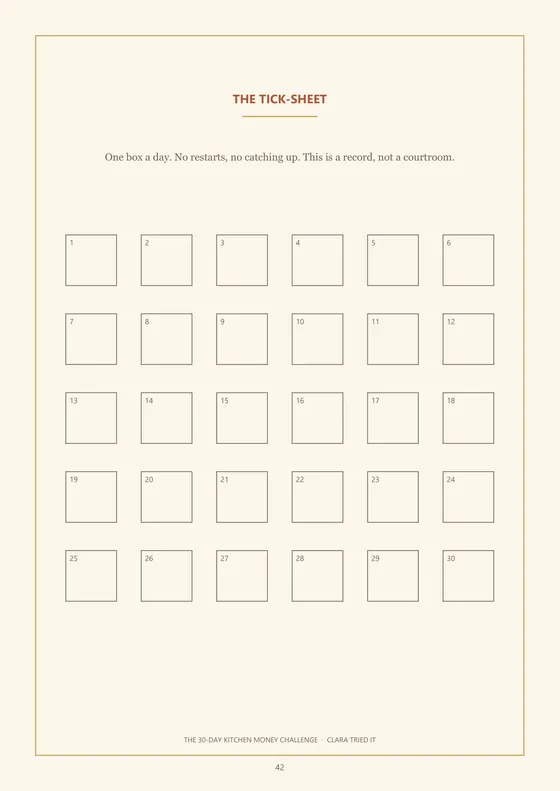
Day 1 of the challenge: the trash receiptThe challenge's tick sheet

The 30-Day Kitchen Money Challenge

Freesend me the PDF

Thirty days, one kitchen habit each, with the arithmetic shown. What earns its place in the cart, what goes in the trash, and what I stopped buying.

  • Week one: what goes in the trash, and the eat-first shelf
  • Week two: the small number on the shelf tag, and one chicken for three dinners
  • Week three: the freezer and the pantry
  • Week four: rags, lunch, coffee and a price book

7-day refund · emailed instantly · PDF + EPUB · Visa, Mastercard, PayPal, Apple Pay

Questions people ask

Is this book for me?

If you run a household and the weekly shop has been getting worse, yes. It assumes no skills and no equipment beyond what is already in an ordinary kitchen. Where something genuinely needs a tool, the chapter says what it costs, and it is usually under twenty dollars.

Do I need a garden?

No. Six of the ninety-nine chapters are about growing things, and every one of them works in pots on a windowsill, a step or a balcony. The other ninety-three are indoors.

Does any of this need me to be handy?

Very little. The repair part is six chapters of small, reversible jobs. Anything electrical, anything at height, and anything involving gas gets handed to a professional, and the chapter says which trade to ring.

Home canning and preserving. Is that safe to follow?

That is the strictest part of the book, and it is strict in an unusual way: it prints no canning recipe of its own. It explains why acidity decides the method, why low-acid food needs a pressure canner and why boiling water cannot substitute, and then it routes every actual process to a currently tested source such as the USDA guide or the National Center for Home Food Preservation. It also says plainly that I am not a food scientist.

Is there medical or financial advice in it?

None, deliberately. Where a subject touches either, the book stops and points at a doctor or at published guidance. There is nothing about investing, debt, benefits or income anywhere in it.

What do I get, and is it a subscription?

One book, as an 858-page PDF and an EPUB, both emailed the moment you buy. It reads on a phone, a tablet, a computer or a Kindle, and it is laid out to print at home. You pay once. Nothing renews.

Can I get it on paper?

Not as a printed book, no. It is a digital book you can print yourself, which is what keeps it at $9.99 instead of what an 858-page hardback would cost.

This one

Tells you where it did not work.

Ninety-nine chapters on the cleaning, the pests, the food, the garden, the pantry, the freezer, the repairs, the bills and the weekly shop. 858 pages. One honest book. $9.99, once.

Not sure yet? Read one chapter first, free. 7-day refund · emailed instantly · PDF + EPUB